



You have a business to run, so here's the short version. AI agents improved a lot this year, and they can now work together on a single job. Yet very few businesses have put them to work.
That's good news for a local owner. Agents are best at the chores you keep pushing to Sunday night. You can try them in small doses with an AI workforce built for local businesses.
This post walks through the Databricks State of AI Agents 2026 report. Then it gives you a rough plan for your first month, if you want to test the idea.
What the 2026 numbers show
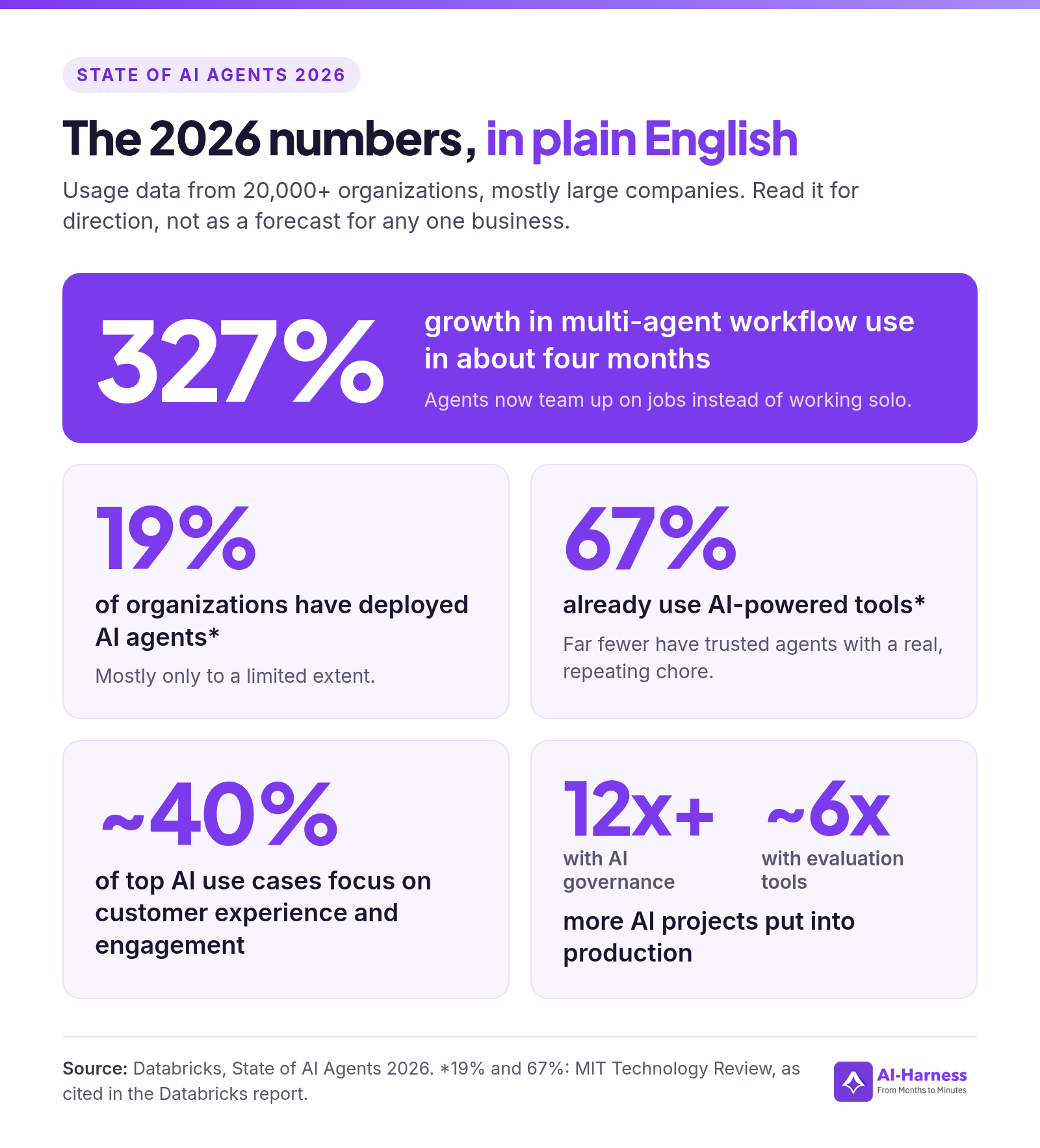
First, where the data comes from. Databricks sells data software to large companies, and it pulled usage figures from more than 20,000 organizations.
Because the data comes mostly from large organizations, treat each number as a sign of direction rather than a rule for your business.
Multi-agent workflow use grew 327% in about four months (Databricks). A "multi-agent workflow" just means a few agents share a job. Think of a small crew: one minds your listings, another drafts review replies, and a third sketches next week's posts.
Now the reality check. Only 19% of organizations have deployed AI agents, and most only a little. That's from MIT Technology Review, as cited in the Databricks report.
If it feels like everyone else figured this out last year, the data says most of them didn't. Still, interest is high: over half of leaders see agentic AI as a force multiplier for operations and decisions (MIT Technology Review, cited in the Databricks report).
A related number: 67% of organizations already use AI-powered tools (MIT Technology Review, cited in the Databricks report). Many people have tried ChatGPT, but far fewer trust a tool with a real chore that comes back every week. That gap is where the time savings are.
About 40% of the top AI use cases are about customer experience and engagement (Databricks). Big companies pointed AI at their customers first. You can do the same with lower stakes, starting with a reply to that review from Thursday.
One more finding stands out. Companies that use AI governance put over 12x more AI projects into production. Companies with evaluation tools get nearly 6x more (Databricks).
"Governance" may sound formal, but it simply means you set the rules for the agent and check what it did.
The report also found that most AI use cases focus on routine but necessary daily tasks, and 96% of AI requests are handled in real time rather than in batches (Databricks). For a local business, that matches the work that matters most: answering a question while the customer is still deciding.
Two more trends sit behind the scenes. AI agents now create 80% of new databases on one platform the report tracks, and 78% of companies use two or more AI model families (Databricks). You don't need to manage any of that. The takeaway is simpler: pick tools that keep your business details accurate and in one place, because agents are only as good as the information they read.
Multi-agent workflows: why 2026 is the year agents work together
The biggest jump in the report is teamwork. Use of multi-agent systems grew by 327% in just four months (Databricks). Instead of one chatbot trying to do everything, several agents each take one part of a job and pass work along.
The report also shows that a "supervisor" style agent, one that hands tasks to other agents, became the top agent use case, with 37% of usage on Databricks' agent tools in October 2025 (Databricks).
What does that look like at a local business? Illustrative example: a dental office closes for a holiday. One agent updates the hours on Google and the website. Another drafts replies to the reviews that came in that week. A third drafts a post about reopening. The front desk approves each one before it goes out.
The same setup fits a restaurant changing its patio hours or a plumber adding a new service area. Each agent has a narrow job, which makes its work easier to check.
The point is not more software. It's fewer small tasks slipping through the cracks on a busy week, with a person still deciding what goes live.
What these numbers mean for your business
You don't need a data team to use this report. The most useful part isn't the tech; it's where agents get used first: customer-facing work that repeats and has clear right answers.
For instance, say your Google listing says you close at 6, but you've been open till 7 since April. Four reviews from last month have no reply. Your last Instagram post went up three weeks ago, right before a lunch rush ate the afternoon. None of it is hard, but it's never urgent either.
Big companies spent months and many engineering hours building agents from scratch. You can skip that step, because agents for these chores already exist. Your job is to decide what can run on its own and what has to ask you first.
Where AI agents help local businesses today
These are the jobs where agents earn their keep right now.
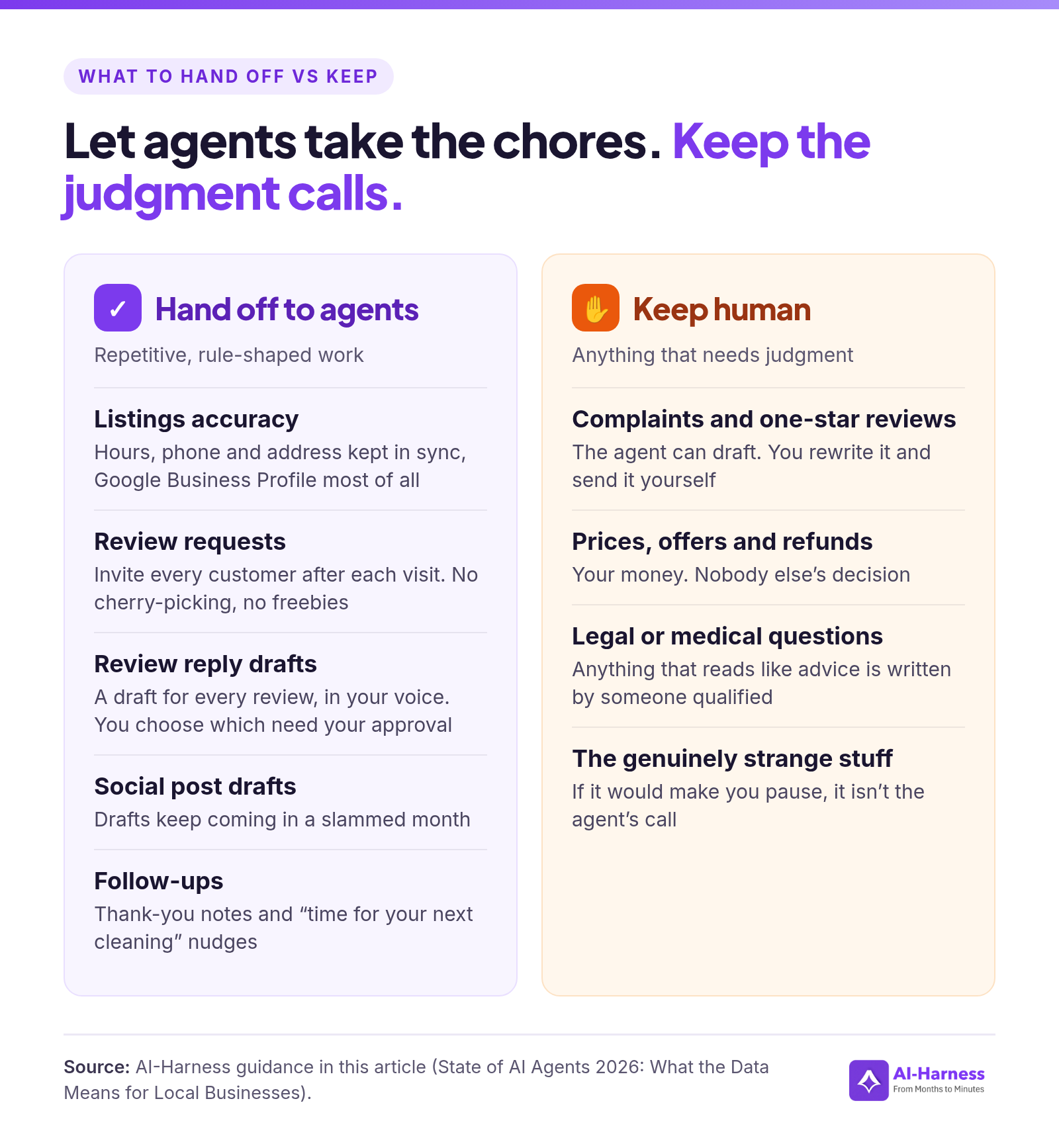
Listings accuracy. People check your hours, phone and address in lots of places. Google Business Profile matters most. When those places disagree, you quietly lose trust with customers. The Visibility & Listing Agent keeps them in sync. There's more on this in AI agents for business listings.
Review requests. The Automated Review Agent invites every customer after each visit. You don't pick who gets asked, there's no reward for leaving a review, and nobody's told what to say. Google's review policy and the FTC want it that way.
Review replies. The Reputation & Sentiment Agent drafts a reply to every review, good or bad, in your voice. You choose which replies need your OK before they post.
Social posts. Feeds go stale fast in a busy month. The Marketing Automation Agent keeps drafts coming, so you always have something ready.
Search and AI-answer visibility. Someone asks Google or an AI assistant for the best plumber near them. Before it answers, that tool reads your site, your listings and your reviews. Nobody can promise you'll show up, so be wary of anyone who does. What agents can do is keep that material accurate and current. That's the part you control.
Want to go deeper? Try the answer engine optimization guide or the local SEO checklist.
Follow-ups. Thank-you notes and "time for your next cleaning" reminders work, but only when they get sent. An agent remembers them, even when a tired owner at 9 p.m. doesn't.
Your business isn't the same as the one next door. See how it plays out for your industry.
What still needs a human
Agents are good at repeat work with clear rules, but they're clumsy with judgment calls. Keep these in human hands:
- Complaints and one-star reviews. An upset customer wants to hear from a person. Let the agent draft if you like, but rewrite it and send it yourself.
- Prices, offers and refunds. It's your money, so it's your call.
- Legal or medical questions. Anything that could read like advice should come from someone qualified.
- The truly odd stuff. If it would make you pause, it isn't the agent's call.
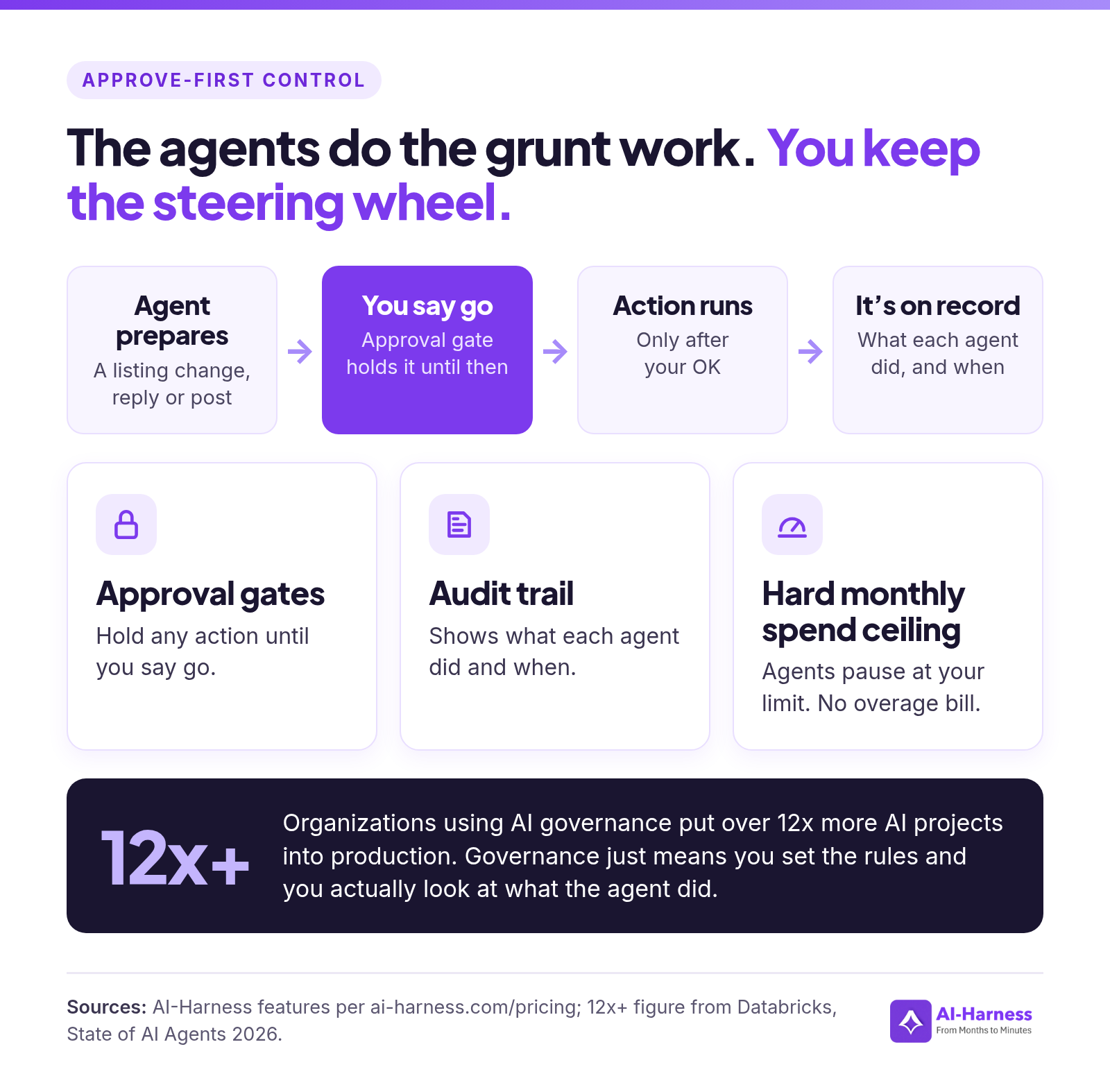
That's why AI-Harness is approve-first. Approval gates hold any action until you say go, and an audit trail shows what each agent did and when.
There's also a hard monthly spend ceiling. Agents pause when they hit your limit, so you never get an overage bill (pricing). The agents handle the routine work while you stay in control.
Governance and testing: why guardrails get agents into production
Many AI projects never leave the test stage. The report points to two habits that change that. Companies using AI governance put over 12x more AI projects into production. Companies using evaluation tools get nearly 6x more (Databricks).
Trust is still a weak spot. In a survey the report cites, 40% of respondents said their AI governance was not enough to keep AI use safe and compliant (Economist Impact, cited in the Databricks report). Only 2% rated their AI highly for measurable business results (MIT Technology Review Insights, cited in the same report).
For an owner, governance means clear rules: what an agent may do alone, what needs approval, and how much it can spend. Evaluation means checking its work on a schedule.
Illustrative example: a home services company lets an agent draft replies to five-star reviews on its own, but every reply to a complaint waits for the owner. Each Friday, the office manager reads a sample of the week's replies and fixes anything that sounds off.
These habits don't guarantee results. They do make it far easier to see what works and keep it running.
Why most AI pilots stall (and how to avoid it)
A "pilot" is a small trial run. The report's biggest lesson is about why they work or don't.
Projects with governance reach real use over 12x more often. Projects with evaluation tools do it nearly 6x more (Databricks).
So put one person in charge of checking the agent's work each week, because a shared job often becomes nobody's job.
Pick a goal you can count. "Reply to every review within two days" works. "Do better online" doesn't.
Leave approvals on for the first two weeks, and loosen them only where the drafts already come out right.
Once a month, take a few minutes and ask what ran, what you had to fix, and what you'd trust it with next.
Most pilots don't fail outright; they drift. Nobody turns them off, but nobody checks on them either. Fifteen minutes each Monday before you open is usually enough to prevent that.
A 30-day starter plan
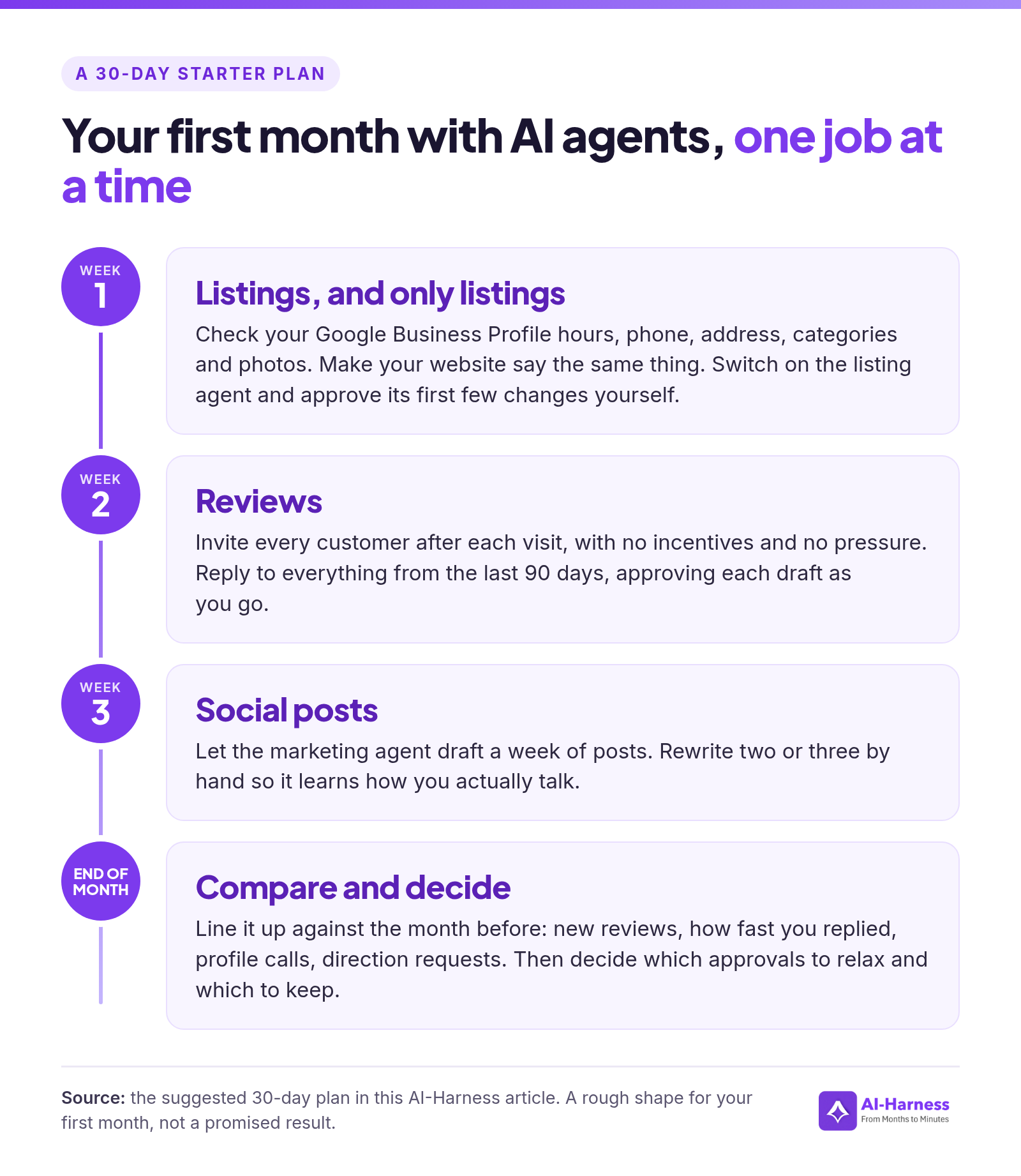
Here's a rough shape for your first month.
Week 1: listings only. Open your Google Business Profile and check the hours, phone, address, categories and photos. Then make your website match, turn on the listing agent, and approve its first few changes yourself. You'll see how it works.
Week 2: reviews. Invite every customer after each visit, with no rewards and no pressure. Then go back through the last 90 days and reply to everything. Approve each draft as you go.
Week 3: posts. Let the marketing agent draft a week of posts. Rewrite two of them by hand so it learns your voice, for example that you say "y'all" rather than "valued patrons."
End of the month. Compare it with the month before. Look at the number of new reviews, your reply speed, profile calls and direction requests. Then decide which approvals to relax and which to keep.
Illustrative example: picture a barber with two chairs. In week one, he fixes old holiday hours and a wrong phone number on a couple of listings. After that, he approves reply drafts on his phone over morning coffee. A month in, he only glances at posts and the odd one-star reply. (Illustrative, not a real customer.)
Case study: Bella Nonna (Austin, TX)
More AI-Harness case studies.
Try it on your own business
The report keeps pointing at the same thing: customer-facing chores, run with rules, with a person checking the work. If that sounds like your week, start a 14-day free trial. There's no credit card and no setup fee, and every agent waits for your OK before it acts. Rather talk first? Book a demo and the AI-Harness team will walk you through it.
How this was made: AI tools helped research and draft this article. The AI-Harness team checked every number against the original report.
AI-Harness (ai-harness.com) isn't related to Harness.io or the Shopify app "AI Harness".
FAQ